
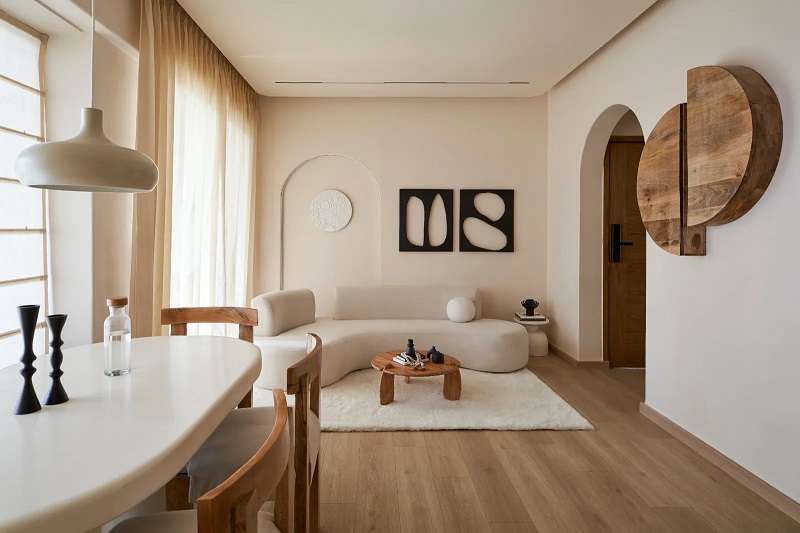
When most people hear the word minimalism, their minds immediately jump to an extreme caricature: bare concrete floors, a lone sculptural chair perched in a cavernous gallery, and walls scrubbed clean of all personal history. For years, lifestyle magazines promoted this austere aesthetic as the gold standard of modern taste. In practice, living inside a white-box void rarely produces peace. More often, it induces a low-grade anxiety, making occupants feel like transient caretakers in an art gallery rather than residents in a home designed to cushion the stresses of everyday life.
Genuine minimalism is not an exercise in deprivation, nor is it about erasing all evidence of human presence. At its core, it is a practice of sensory editing and intentional living. It is the conscious choice to surround yourself only with furnishings and objects that carry functional weight, aesthetic integrity, or deep sentimental value. When executed properly, a minimalist home does not feel cold or empty; it feels resolved. The nervous system settles because the eye is no longer forced to process dozens of competing visual distractions. Achieving this balance requires moving beyond basic tidying and treating interior space with architectural discipline, material warmth, and spatial intention.
Mastering Negative Space as an Active Design Element
In traditional decorating, an empty corner or an unadorned wall is often treated as a problem waiting to be solved. Homeowners feel an instinctive compulsion to fill every niche with a console table, a decorative pedestal, or an elaborate gallery wall. In minimalist interior design, however, negative space operates as an active, structural element rather than an unfinished void.
Just as pauses give music its rhythm, empty space allows the architecture of a room and its primary furnishings to breathe. When a well-crafted walnut dining table sits in an open expanse without crowded sideboards or flanking plant stands, its silhouette, grain, and proportion take center stage.
To cultivate genuine calm, resist the reflex to fill floor planes edge-to-edge. Leave generous margins around major seating arrangements, preserve wide, unobstructed circulation pathways, and allow at least one or two primary walls in each room to remain completely blank. This deliberate restraint immediately drops the visual temperature of a room, creating an expansive, airy feeling regardless of the home’s actual square footage.
Building Warmth Through Materiality and Tactile Layering
When color palettes are restricted to muted neutrals—soft taupes, warm creams, chalky grays, and muted earth tones—spaces run the risk of looking flat and sterile under everyday daylight. The antidote is not reintroducing chaotic patterns or high-contrast accent walls, but leaning heavily into tactile materiality.
A calm room should engage the sense of touch just as much as sight. Instead of relying on decorative trinkets to build visual interest, let the raw authenticity of organic materials carry the weight of the room:
Organic Woods and Honed Stone
Incorporate woods with natural character, such as white oak, walnut, or weathered ash, finished with low-sheen oils rather than reflective varnishes. Pair them with natural stone surfaces—such as honed limestone, travertine, or soapstone—whose matte, irregular surfaces absorb light gently rather than bouncing harsh glare across the living area.
Unstructured Natural Textiles
Ditch stiff synthetic blends in favor of textiles that reveal subtle weave and physical movement. Slubby washed linen drapery that puddles slightly on the floor, wool flatweave rugs, nubby bouclé upholstery, and raw silk throw cushions introduce microscopic shadows and varied depth. Because the color palette remains harmonious, the brain registers cohesion, while the body registers physical warmth and comfort.
Eliminating Visual Noise with Concealed Storage
Decluttering is often treated as an ongoing weekend chore, but persistent mess is usually a symptom of inadequate architectural planning. True visual quiet cannot exist if daily essentials—mail, charging cables, work laptops, exercise gear—are continuously visible. Every object left sitting on an exposed surface exerts a subtle micro-demand on your attention, a cognitive drag designers call visual noise.
Open shelving, while photogenic in staged settings, is notoriously difficult to maintain in a functional household because it demands constant curating and dusting. For a genuinely peaceful home, favor closed, flat-panel cabinetry that integrates flush with the surrounding wall planes. Built-in consoles, floating credenzas, and armoires with touch-latch or integrated J-pull handles eliminate visual clutter while offering deep, accessible storage.
When planning storage, designate strict, dedicated homes for transient objects. A discrete drop-zone inside an entryway closet or a lidded woven basket next to the sofa keeps daily debris out of sight. If an item does not possess a permanent, concealed home inside a drawer, cupboard, or storage bench, it simply does not belong in the primary living space.
Curating Decor with the Power of the Singular Focal Point
One of the most transformative shifts in minimalist decorating is trading dozens of small accessories for a single, impactful focal point. A mantelpiece cluttered with seven small candles, three framed prints, and a decorative tray fragments attention. Replace that assortment with one oversized architectural branch in a heavy stoneware vessel, and the entire room suddenly feels grounded, quiet, and deliberate.
Apply this principle across every room:
-
Art curation: Choose one substantial canvas or a pair of large-scale, framed abstract works with generous white matting rather than a disjointed gallery wall with a dozen competing frames.
-
Functional objects as decor: Let beautiful, everyday objects serve as the ornamentation. A sculptural ceramic pour-over carafe on a kitchen counter or a hand-turned wooden bowl on a coffee table eliminates the need for purely decorative filler.
-
Biophilic punctuation: Avoid scattering small, assorted potted plants across every windowsill. Instead, invest in a single architectural tree—such as an olive tree, black ficus, or money tree—in a substantial neutral planter to anchor the room with sculptural life.
Sculpting Ambiance with Low-Lumen Layered Lighting
Few design missteps destroy the tranquility of a space faster than the harsh, downward beam of an unshielded overhead light fixture. Bright ceiling downlights flood rooms with clinical glare, flattening textures and casting stark shadows across living spaces.
To create an atmosphere that genuinely invites decompression, rethink lighting as a three-dimensional landscape. Turn off the central ceiling fixture in the evening and rely entirely on diffused, low-level illumination:
-
Position table lamps and floor lamps at varying elevations—between waist and eye level—so light pools softly in different functional corners of the room.
-
Select lampshades crafted from opaque linen, washi paper, or frosted glass to diffuse the light evenly and eliminate bare-bulb glare.
-
Standardize all bulbs across the home to a warm color temperature between 2700K and 3000K. Warm light softens architectural angles, enriches natural wood grains, and signals to the circadian system that it is time to unwind.
Creating a calm, clutter-free home is ultimately an ongoing commitment to personal curation rather than an overnight shopping spree. It asks you to slow down, interrogate the necessity of what crosses your threshold, and honor the physical envelope of your living space. By prioritizing natural light, structural breathing room, rich organic textures, and functional concealment, you strip away the static of the modern world. What remains is not an empty house, but an intentional sanctuary built for rest, clarity, and daily restoration.