
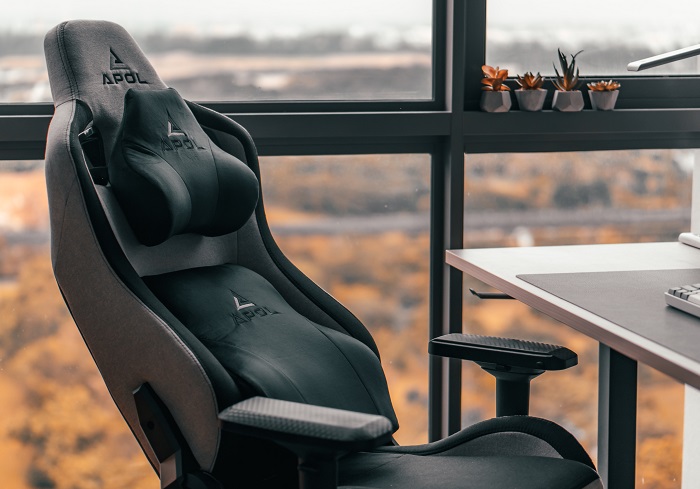
Most desk workers know the exact moment an office chair turns against them. It usually strikes around mid-afternoon: a persistent dull ache in the lower back, tightening shoulders, and an instinctive urge to slump forward over the keyboard. Most commercial office chairs are built for durability and aesthetics rather than genuine spinal health. They feature flat, rigid backrests or flimsy mesh frames that provide little to no support where your body needs it most.
Replacing a standard desk chair with a commercial-grade ergonomic task chair can easily set you back a thousand dollars. Fortunately, upgrading your existing setup rarely requires an overhaul of your furniture. A well-designed lumbar support add-on can correct the biomechanics of an unforgiving seat, restoring your spine’s natural curve and eliminating daily fatigue at a fraction of the cost.
Why Standard Office Chairs Fail Your Lower Back
The human spine is naturally curved like an elongated S. The lower back, or lumbar spine, curves inward toward your abdomen in a natural arch called lordosis. When you stand, this inward curve helps distribute your upper body weight evenly across your vertebrae and pelvic girdle.
Sitting drastically alters this equation. As you sit, your pelvis tends to rotate backward, flattening the natural inward curve of your lower spine. Without firm, properly positioned resistance behind your beltline, the lumbar spine bows outward into an unnatural C-shape. This posterior pelvic tilt loads tremendous hydrostatic pressure onto your intervertebral discs, strains the surrounding paraspinal muscles, and encourages a forward head posture that cascades tension all the way up to your neck.
A quality lumbar add-on does not simply cushion your back. It acts as an active physical wedge that fills the gap between your lower torso and the chair’s backrest, stabilizing your pelvis and mechanically maintaining healthy lumbar lordosis without conscious muscular effort.
The Best Types of Lumbar Add-ons for Desk Workers
Lumbar supports are not one-size-fits-all accessories. The best choice depends on your chair’s frame, your body type, and how warm your office runs.
Contoured High-Density Memory Foam Cushions
Contoured memory foam pillows represent the most popular style of chair add-on, and for good reason. These cushions are molded to cradle the lower thoracic spine and the small of the back, flaring out slightly on the sides to prevent lateral shifting.
Samsonite Ergonomic Lumbar Support Pillow and similar high-density memory foam models excel in general task chairs. Because high-density foam reacts to both body heat and pressure, it shapes itself to your lumbar curve while providing structural firmness that will not collapse after three hours of continuous use. Look for options with dual adjustable straps; a single center strap almost always slides downward against slick upholstery.
Orthopedic Lumbar Rolls
Originally popularized by physical therapists and spinal specialists, cylindrical and D-shaped lumbar rolls take a minimalist, highly targeted approach. Instead of covering the entire backrest, an orthopedic roll sits directly against the lumbar apex, right around the beltline.
The OPTP Original McKenzie Lumbar Roll remains the gold standard in this category. Its compact, firm cylindrical shape acts as a direct fulcrum that pushes the lower lumbar vertebrae forward, making it almost impossible to slouch. Rolls are particularly effective for chairs that already have decent upper-back support but leave a hollow void behind the lower spine. They are also exceptionally portable, making them ideal for hybrid workers who split time between a home office, a corporate cubicle, and daily commutes.
Hyper-Elastic Gel and Polymer Grids
Traditional foam has one major drawback: it traps ambient body heat. If you work in a warm environment or run hot throughout the day, solid memory foam cushions can quickly become uncomfortable.
Hyper-elastic polymer designs, such as the Purple Back Cushion, resolve this issue by replacing foam with an open-cell, column-buckling gel grid. This material yields under high-pressure points like the bony landmarks of the spine while remaining completely rigid across broader contact zones. The open channels allow air to circulate continuously, keeping your back cool during long stretches at the desk.
Breathable Mesh Lumbar Backrests
For chairs with deep bucket seats or soft, sagging fabric, lightweight mesh back supports offer a suspended alternative. These frames use a flexible spring-wire perimeter wrapped in tight, breathable mesh. They clip directly around the chair back and create a spring-loaded bow that meets your lower back. While they offer less customized pressure relief than sculpted foam, they are remarkably lightweight, keep you cool, and prevent you from sinking too deeply into an overly soft chair.
Critical Features to Consider Before Choosing an Add-on
Selecting the right lumbar support requires matching the cushion’s dimensions to both your chair and your physique.
-
Cushion thickness versus seat depth: If your office chair already has a shallow seat pan, adding a thick, three-inch memory foam block will push your hips forward. This reduces thigh support and causes your knees to hang awkwardly past the edge. For shallow seats, choose a slim contoured cushion or a tapered D-roll. If your seat pan is exceptionally deep, a thicker full-back cushion helps bring your torso forward into proper alignment.
-
Foam density and compression resilience: Inexpensive lumbar cushions often use soft polyurethane foam that feels plush out of the box but flattens into a thin pancake under real weight. Premium add-ons utilize dense, molded visco-elastic foam that provides steady, resilient resistance throughout an eight-hour shift.
-
Securing mechanisms: Pay close attention to how the cushion fastens. Office chair backs come in dozens of shapes and widths. Broad, elastomeric straps equipped with heavy-duty plastic buckles are mandatory. Dual-strap systems allow you to anchor the cushion both horizontally and vertically, eliminating the annoying habit of re-adjusting your pillow every time you stand up.
-
Cover material and hygiene: Desk accessories accumulate dust, sweat, and friction over months of use. Always choose an add-on that features a removable, machine-washable outer sleeve made of 3D breathable spacer mesh or soft, moisture-wicking synthetic fibers.
How to Position Your Lumbar Support for Maximum Relief
Even the best lumbar accessory will fail to relieve back pain if it is placed incorrectly. The most common mistake desk workers make is letting the cushion rest directly on the seat pan, which pushes the sacrum and buttocks forward rather than supporting the lumbar arch.
To position your add-on properly, sit all the way back in your chair so that your hips touch the rear of the seat. Reach behind you and place the thickest, most protruding section of the cushion directly into the natural curve of your lower back, roughly two to three inches above your beltline. The support should feel as though it is naturally filling the space behind your spine, gently nudging your chest upward without digging uncomfortably into your ribs.
Once your lumbar add-on is positioned, adjust your chair’s height so that your feet rest flat on the floor with your knees bent at roughly a ninety-degree angle. This stabilizes your pelvis and allows the lumbar add-on to support your upper body with minimal effort.
A bad office chair does not have to dictate your physical comfort or work productivity. By adding targeted, high-density lumbar support to your current chair, you can transform a punishing seat into an ergonomically sound workstation that keeps you supported, upright, and pain-free throughout the workday.